

This post is also available in:
How live entertainment can help Alpine hotels attract locals, keep guests in-house and build a bar people actually seek out
A hotel bar can be beautifully designed, serve excellent cocktails and sit in one of the best locations in the French Alps — and still be somewhere guests walk through rather than somewhere they actively choose to spend their evening.
That is the difference between simply having a bar and creating a destination.
For hotels in ski resorts, the opportunity is particularly interesting. Every afternoon, hundreds of guests come off the mountain looking for somewhere to warm up, have a drink, meet friends or continue the day. Later, they are deciding whether to stay in the hotel, head into the resort centre or try somewhere they have heard about.
A strong bar concept can turn that natural flow of people into something much bigger: a reason for residents to stay, a place locals recommend and somewhere non-residents deliberately visit.
And live entertainment can play a huge part in making that happen.
The best hotel bars aren’t only for hotel guests
There is nothing wrong with a quiet residents’ bar. For some hotels, that is exactly what the space needs to be.
But if the aim is to create atmosphere, increase footfall or develop another part of the hotel’s identity, relying exclusively on people who already have a room upstairs can be limiting.
The hotel bars that become part of a ski resort’s wider social scene tend to attract a mixture of people.
Hotel residents sit alongside chalet guests. Locals bring friends. Seasonal workers come back week after week. Holidaymakers hear about a particular night through their chalet host, instructor or concierge and decide to visit.
Suddenly, it stops feeling like somewhere people happen to be because they are staying in the building.
It becomes somewhere people choose to go.
That distinction matters.
A busy, recognisable bar adds something to the guest experience, but it can also create additional food and beverage revenue, generate repeat local business and give the hotel a stronger presence within the resort itself.
Give people a reason to come on a particular night
“We have live music occasionally” is very different from having an event people remember.
In a ski resort, regularity is incredibly powerful.
A Thursday acoustic session. A Friday live night. Sunday après on the terrace. A sunset DJ session once a week.
It does not need to be complicated.
What matters is creating something recognisable enough that people begin to associate a particular night with a particular venue.
Instead of:
“There might be a singer there tonight.”
You want:
“It’s Thursday! That’s their live night.”
That gives hotel guests something to look forward to, but importantly, it also gives people outside the hotel a reason to make the journey.
Over the course of a winter season, one strong weekly event can develop far more identity than a calendar full of unrelated entertainment that changes constantly.
Your hotel does not need to become an après-ski nightclub
One of the biggest misconceptions around live entertainment in ski resorts is that it automatically means loud bands, packed dance floors and someone standing on a table in ski boots by 5pm.
Sometimes that is exactly what a venue wants.
Often it isn’t.
Entertainment should fit the property.
For a luxury hotel, that might mean a sophisticated acoustic duo in the early evening, a pianist and vocalist around the bar, jazz, soul or a carefully chosen DJ.
A terrace might lend itself to a livelier après session once a week, while the rest of the programme remains relaxed.
A restaurant might want music that initially sits comfortably in the background before becoming more upbeat as dinner finishes.
The question is not simply “Which artist should we book?”
It is:
“How should this room feel at this particular moment?”
The right artist for a busy après bar may be completely wrong for an elegant hotel lounge.
Likewise, an incredible musician who cannot control their volume, read a room or adapt their set may be far less successful in a hotel environment than someone who understands exactly what the space requires.
Programming well is about matching the artist to the venue, the guests and the time of day.
Think about the whole ski day, not just the evening
One of the advantages Alpine hotels have is that the day already has a natural rhythm.
Guests leave in the morning and gradually return from skiing during the afternoon.
At around 3pm or 4pm, people want warmth, drinks and somewhere comfortable to sit.
A little later, après begins.
Then comes the awkward transition between après and dinner — the point where people either stay in your bar or decide to leave the hotel entirely.
Later still, the mood changes again.
Entertainment can help shape those different moments.
An acoustic artist might work perfectly as guests arrive back from the mountain.
A DJ or livelier live act can lift the energy during après.
Later in the evening, the atmosphere can soften again around cocktails and dinner.
Rather than thinking of entertainment as a two-hour performance dropped into the middle of the day, think about how the atmosphere of the bar changes from afternoon through to evening.
The strongest concepts often feel natural because the entertainment fits into what people already want to do.
Why the local crowd matters
Hotel guests change every week.
Locals don’t.
That makes the local audience particularly valuable in a ski resort.
They create repeat business during quieter periods, bring visiting friends, recommend venues and help establish which places become part of the resort’s social landscape.
They also change the atmosphere of a hotel bar.
A room occupied exclusively by residents can sometimes still feel exactly like what it is: a hotel bar.
Mix residents with regular local faces, seasonal staff, chalet guests and people who have actively travelled across the resort to be there, and the dynamic changes.
It feels connected to the destination.
Of course, that does not mean every hotel should suddenly target the entire seasonal workforce with cheap drinks and a nightclub DJ.
The local audience you want depends completely on the identity of the property.
The important thing is creating something that people outside the hotel feel they are welcome to be part of.
In the French Alps, reputation travels incredibly quickly. A successful night can become part of people’s weekly routine surprisingly fast.
Entertainment gives your marketing team something to talk about
There is another advantage which is easy to overlook.
A regular entertainment programme creates content.
Without events, a hotel’s social feed can very quickly become an endless rotation of bedrooms, cocktails, food and mountain views.
All lovely things.
But they do not always give people a reason to engage right now.
Live nights create movement.
Artists.
Crowds.
Short videos.
Guest content.
Weekly posters.
Stories.
Event listings.
Something your concierge can recommend.
Something the tourist office can potentially share.
A regular event also gives the hotel an ongoing story.
You are no longer trying to invent a completely new reason to post every week because the concept already exists. Your marketing simply builds around, and when an event develops its own identity, people begin marketing it for you. They tag the venue. They share the artist. They tell people they are coming back next Thursday. That is where a weekly event starts becoming more valuable than just the drinks sold during the performance itself.
You don’t need seven nights of entertainment
Creating a destination bar does not mean filling the calendar every evening.
In fact, doing too much too quickly can have the opposite effect.
One properly planned and consistently promoted night can be far more powerful than several events that nobody can remember.
Start with a gap.
Perhaps Thursday is traditionally quiet.
Perhaps Sunday afternoon has potential but no real identity.
Perhaps guests regularly leave the hotel after skiing and you would like to keep more of them in-house.
Build something specifically around that problem.
Give it time.
See who comes.
Watch how guests use the space.
Listen to feedback from the bar team.
Then adapt.
If it works, the programme can grow naturally through the season, with larger events around Christmas, New Year, school holidays or other key periods.
The goal is not entertainment for entertainment’s sake.
It is to create something that makes commercial and operational sense for the venue.
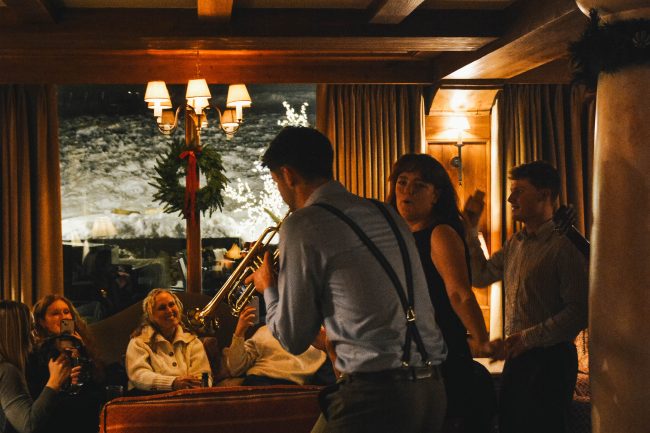
Hot Piece of Brass strolling at Le Portetta in Courchevel
A successful hotel entertainment concept starts with the venue
At Piste Productions, we don’t believe there is one entertainment formula that works for every hotel or bar.
A successful programme starts by understanding the property.
Who are your guests?
What atmosphere are you trying to create?
Which days already work?
Which days need help?
Do you want to attract people from outside the hotel?
Is the priority après, evening drinks, restaurant atmosphere or late-night entertainment?
How much space do you have?
What sound restrictions exist?
What does your brand look and feel like?
Only then does it make sense to start talking about artists.
Being based in the French Alps also means understanding some of the realities behind running events here.
Resort access, artist transport, accommodation, equipment, winter weather and technical requirements can all affect what looks like a very simple booking on paper.
Sometimes the right answer is a solo artist with minimal production.
Sometimes it is a DJ and sax combination.
Sometimes it is a full band, sound engineer and complete technical setup.
And sometimes the best answer is to build one strong weekly concept and let it become part of the venue’s identity.
How can a ski hotel attract more people to its bar?
Creating a clear reason to visit is usually more effective than simply advertising the bar itself.
A recognisable weekly event, strong food or drink concept, terrace session or regular live entertainment gives non-residents something specific to travel for.
Consistency is important: the easier the concept is to remember, the more likely people are to return and recommend it.
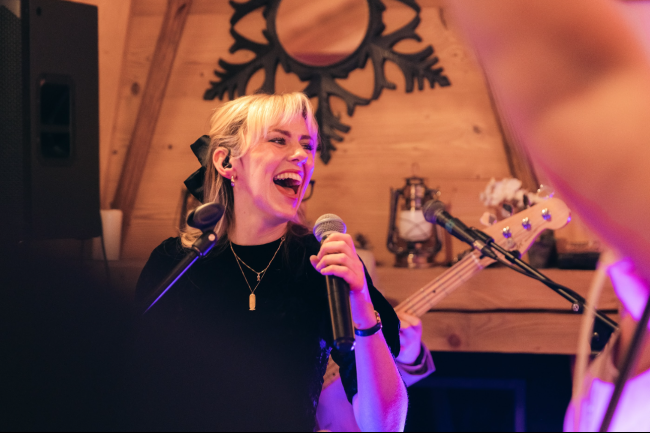
Cydney Brown from Magnolia performing in Megeve
What type of live entertainment works in a hotel?
There is no single format that works for every property.
Acoustic musicians, DJs, pianists, jazz and soul artists, duos, full bands and DJ/live-instrument combinations can all work well depending on the space.
The most important factors are the venue’s identity, the desired atmosphere, guest profile, timing and the performer’s ability to adapt to the room.
How often should a hotel programme live entertainment?
More is not necessarily better.
For many Alpine hotels, one strong recurring event each week is a good starting point.
Programming can then increase around peak holiday periods, special events or dates where there is clear demand.
The aim should be to build something guests and locals recognise, rather than filling every available evening.
Can live entertainment help attract non-resident guests?
Yes. Particularly when the event is regular and promoted outside the hotel.
A recognisable live night or après concept gives locals, chalet guests and visitors staying elsewhere a reason to visit the property.
Over time, this can help a hotel bar become part of the wider resort scene rather than being used solely by residents.
Planning your winter entertainment programme?
Whether you already know exactly what you want or you’re starting with a blank winter calendar, Piste Productions can help develop an entertainment concept around your venue, your guests and your budget.
From one weekly live night to a complete winter programme, we can help with artist selection, programming, technical requirements and the practicalities of producing entertainment in the French Alps.
Already Working With Hotels and Hospitality Venues Across the Alps
This is something we already do week in, week out. Piste Productions works with hotels, hotel groups and hospitality venues across the French and Swiss Alps, as well as further afield. Our clients and partners include The PIG Hotels, Maisons Pariente, Altapura and Hotel Koh-I Nor in Val Thorens, Le Tremplin in Morzine and Farinet in Verbier, alongside established Alpine venues such as Le Rond Point in Méribel and Cocorico. We also work with organisations including Méribel and Courchevel, giving us a particularly strong understanding of how hospitality, tourism and entertainment fit together in mountain resorts. That experience means we’re used to very different briefs — from creating relaxed live music for a hotel terrace to building regular après concepts, programming peak-season events or delivering the full technical production behind a much larger night. The aim is never to impose the same formula everywhere, but to create something that feels right for the property, its guests and the resort around it.
